Resonance
as they travel through your mouth and nose, or oral and nasal cavities. Different sizes and shapes of cavities can greatly affect the timbre (TAM-burr), or texture, of the sound produced. The larger the cavity, the darker and richer the sound produced; the smaller cavity, the brighter and thinner the sound. Versatile singers and voice actors can change the shape of their vocal tract to produce different vocal qualities and singing styles (see here); the same can be done for the speaking voice to adjust the speakers' timbre.
The Resonance of Vowels
Whether or not you know it, you change your resonance all the time throughout the day as you produce voice! Different vowel sounds are achieved by moving one's tongue, jaw, and lips. As these move to different positions for different sounds, different mouth shapes, and thus different resonance patterns, are produced. For this exercise, we're going to be experimenting with the 'eee' vowel (as in "email") and 'ahh' vowel (as in "box").
-Say the 'eee' sound several times in a row, letting your tongue relax in between each production. What does your tongue do to produce this vowel?
-Repeat the exercise with the 'ahh' vowel. What does your tongue do differently for this sound?
Chances are, for the 'eee' vowel, your tongue moved up and forward in your mouth. This reduces the size of the oral cavity, resulting in a bright, thin, forward resonance. Inversely, the 'ahh' vowel is produced by lowering the tongue and moving it back, increasing the size of the oral cavity and producing a dark, rich resonance.
Every vowel has a unique resonance pattern- this is how one can hear the difference between them (Raphael, Borden, & Harris, 2007).
Application in Gender-Affirming Voice Work
Speaking in broad generalizations, female-assigned-at-birth people have smaller heads on average. This means that the oral cavity, too, is smaller, resulting in an overall brighter, thinner sound. The inverse is true for male-assigned-at-birth people– larger heads mean a larger oral resonance chamber and a darker, richer overall sound (Adler, Hirsch, & Mordaunt, 2012).
Combining this with our knowledge of vowel resonance patterns, we can adjust clients' tongue positioning across all sounds to either make their resonance darker and richer (by moving closer to the 'ahh' sound) or thinner and brighter (closer to the 'eee' sound), depending on that clients' preferences.

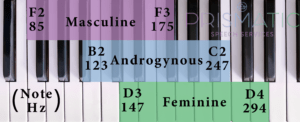 Masculine-perceived voices tend to fall in the 85-175 Hz range; androgynous-perceived voices range from 123-247 Hz; and feminine-perceived voices typically are between 147-294 Hz. Having a voice that falls outside these norms does not mean one has a voice that isn't masculine, feminine, or androgynous; these are merely how the average ear interprets gender based on pitch. A voice that averages at 240 Hz can still be masculine, and a voice at 90 Hz can still be feminine, and neither of these voices need to be changed, especially if the user of that voice is happy with their presentation. There are women with deep voices, there are men with high voices, and there are non-binary people who have voices that aren't androgynous. These people's identities are absolutely valid and they should not be silenced or disregarded due to their vocal qualities.
Leave a Comment
(0 Comments)