Meet Kevin Dorman | Prismatic People
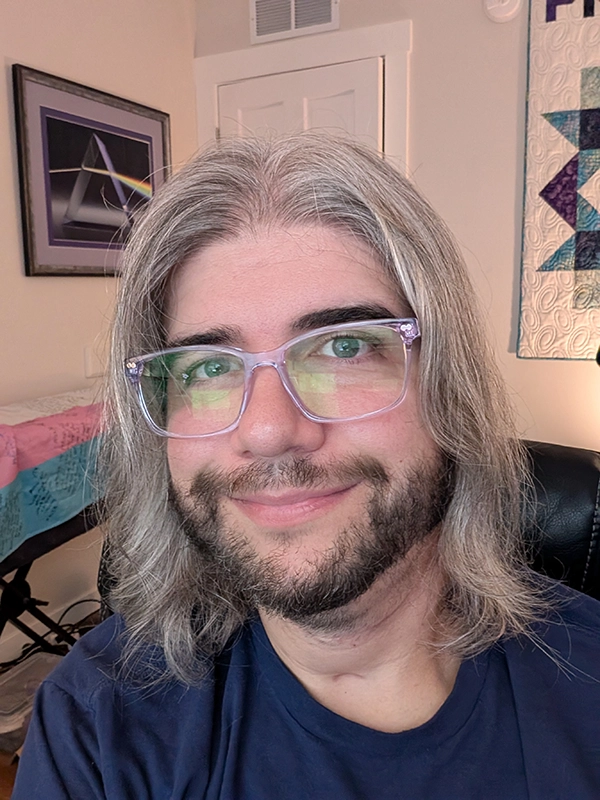
Kevin Dorman, MS, CCC-SLP
Prefer an auditory experience? Listen to a 2023 interview with Kevin on the podcast, "Dingbat Diaries!"
Tell me your name, identity/pronouns, and state(s) you’re licensed in.
My name is Kevin Dorman, I use they/them pronouns, and I’m licensed in Virginia, North Carolina, South Carolina, Georgia, and Kansas!
What do you like to do outside of Speech-Language Pathology? What are your passions or hobbies, what fandoms are you in?
Outside of SLP, I’m a big dorkus; I love playing video games (currently Mario Kart World, Balatro), listening to D&D podcasts (Dungeons and Daddies, The Adventure Zone, NADDPOD), and watching any and all content dropout.tv produces. I greatly enjoy singing (for pleasure, no concerts please!) and have been doing my best to nurture my latent green thumb.
Tell me about your relationship with your voice. Has that evolved as your self-conceptualization has evolved? How has it changed, how has it stayed consistent?
I have a wonderful relationship with my voice; helping others achieve that same love is one of the primary reasons I opened Prismatic Speech Services back in 2016! I’ve enjoyed playing with my voice since I was little; imitating cartoon and video game characters was a primary source of bonding and joy for me and my family. Later on, I got involved in chorus (general and auditioned “all-male” choir, as well as an “all-male” acapella group. They never knew they had a spy in their midst, but to be fair, I didn’t know I was a spy at the time). I began questioning my gender identity when I was 20, and noticed that my voice became much lighter in texture and more varied in pitch completely subconsciously; I think the euphoria of finally knowing who I was, and feeling unburdened of masculine expectations of self-expression, were both very freeing factors.
What gives you vocal euphoria?
Singing, absolutely; silly voices, for sure. Before I was an SLP, I was a voice actor for about half a dozen years, and loved entertaining others with my range and vocal control. However, my connection to these modalities took a massive hit when I was diagnosed with tongue cancer in November of 2024. Since my surgery, radiation, and rehabilitation, it’s been a struggle to reconnect with these passions of mine and not feel discouraged by the increased difficulty. On the other side of that coin, I so very badly want to achieve that level of effortless connection that it’s become a primary motivation for keeping up with my rehabilitation exercises!
As trans folks, we’re hardly given a manual for transition; no one’s transition story is the same. Tell me a bit about your transition journey; how did you get to where you are today?
My transition journey has been somewhat boring, to be honest. Questions about identity weren’t really part of my consciousness when I was growing up. I had a friend who came out as a trans woman in high school, but never really thought about how such labels could apply to me. I do know that I was uncomfortable being thrust into masculine gender roles, and had a difficulty bonding with men the way I saw other men do. I figured out I was bisexual when I was 17, and then I began questioning my gender identity when I was 19-ish. Thanks to my then-boyfriend-now-husband, and to the research and education provided by some friends and resources online, I began to explore, first identifying as gender-fluid, then non-binary. Gender-fluid never felt quite right as a label for my identity; I didn’t feel much pull towards femininity, and didn’t appreciate being gendered male either, and these feelings didn’t fluctuate all that much. I finally realized that I was most comfortable in the less-defined, non-binary space; I also ditched the label of “bisexual” for the delightfully open-ended label of “queer.”
Did your identity have any impact on your career path? How did you find your way to gender-affirming voice as a specialty?
Oh, absolutely; I learned about gender-affirming voice work at the same time I was learning about my own identity. It seemed like the perfect synthesis of my primary interests at the time; I knew that it’s what I had to specialize in, and began pursuing that specialization as passionately as I could. I was lucky enough to connect with my early career mentor, Leah Helou (she/her), at a voice conference when I was in grad school, and she graciously helped me find high quality resources, provide insight on challenges with early clients, and build confidence in my ability to serve the community utilizing my unique skills.
Our field’s demographics tend to trend more conservative and homogenous; the biggest block of SLPs are cisgender, heterosexual, white, Christian, conservative women. How have you navigated this?
Carving out spaces where the percentages are a little better balanced! Early on in my career, I joined several online communities centered around gender-affirming voice work, which naturally attracted a more diverse base of providers. A few friends and I started the Trans Voice Initiative to provide education for trans and non-binary SLPs and other voice professionals.
Has gender-affirming voice work played a role in your transition (i.e. have you received gender-affirming voice work, formally or informally)? If so, what expectations did you have about how the process would go, and were there any misconceptions you had to work through?
I suppose I did informally pursue gender-affirming voice work through my general vocal exploration and experimentation; I hadn’t thought of it that way, but I definitely pushed against the confinements of gendered expectations of voicing through play; this was a challenging internal barrier to break through. For the longest time, I refused to even attempt a more feminine-sounding vocal presentation. It’s hard to pin down exactly why; I think it was too vulnerable a place for me to access at the time, and opened me up to questions I was not prepared to ask myself. I did also receive transgender vocal training for a semester while I was in grad school.
What was your experience like, going through this process as a client?
The experience of being a client was… interesting. For context, I was attending a university in rural, conservative North Carolina. The student I worked with was a very well-intentioned, very progressive woman from Asheville, and I had specifically chosen to work with her because I felt she would be the safest option amongst my cohort. This instinct proved to be true; she did everything in her power to provide services in an area of speech-language pathology she was not familiar with, and I’m very grateful for the work we carried out together. What I couldn’t predict was how her supervisor would negatively impact our work; the faculty member insisted on misgendering me in documentation, and provided very reductive, outdated gender norms for us to operate in. Additionally, it was difficult to find places and situations where I felt comfortable enough to practice the techniques we reviewed. Silver lining: I learned how important it is to listen to the client’s desires over the expectations of society/the clinician, and found many creative ways to practice while living in unsupportive environments (a common experience for much of our clientele, unfortunately).
Is there anything else you’d like to share with the viewers who may be considering pursuing gender-affirming voice work?
There’s no wrong time to begin gender-affirming voice work. If you are feeling anxious, dysphoric, or curious about your voice, please don’t hesitate to reach out for a free consultation. We are here to help you make the best decision for yourself, not to push our own paid services, and we will be honest if we think you could be better served elsewhere.
Leave a Comment
(0 Comments)