
Meet Taylor Mashburn | Prismatic People
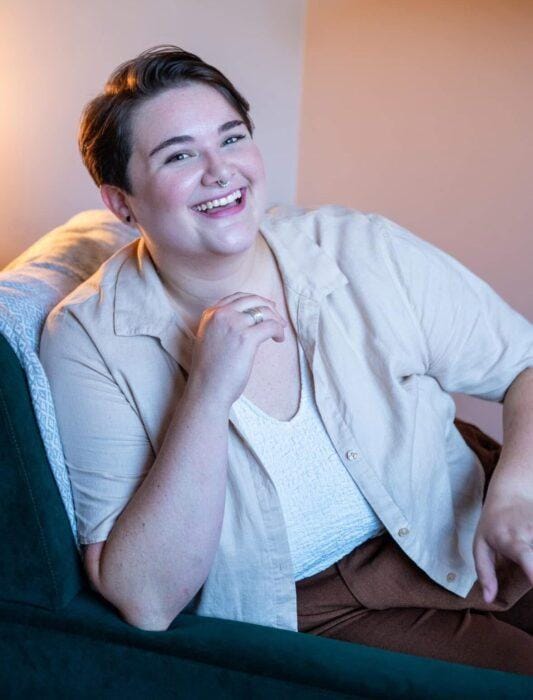
Tell me your name, identity/pronouns, and state(s) you’re licensed in.
My name is Taylor Mashburn. I am a Lesbian. I use she/her pronouns, and just recently moved back to North Carolina. I lived in Knoxville, TN (Go Vols!) for about 5 years before moving back.
What do you like to do outside of speech-language pathology?
I really love fantasy worlds, and mythology. I loved ACOTAR (A Court of Thorns and Roses). I am currently reading the TOG (Throne of Glass) series. I am a big Supernatural fan as well. When I was a kid I was obsessed with fairies, and Egyptian mythology. As a middle schooler that transitioned into a love of Norse mythology and Greek mythology. Percy Jackson and the Lightning Thief, anyone? I love to go DANCING! I have been a dancer since I was put into that world at about 3-4 years old. I stopped dancing in high school and picked it back up around 2021, and haven’t stopped since. I have recently started rock climbing and am really enjoying that as well. Staying active is a huge part of my life, and helps me stay grounded when I am feeling down or overwhelmed with the amount of “To-Do’s” that adult life has to offer.
Tell me about your relationship with your voice.
My relationship with my voice has been one that was one I never paid attention to, until I was on break from college waitressing for the summer. A friend of mine came to visit me and she noted how high pitched my voice would become with my “customer service” voice. I have always had a lower voice (compared to other cis women- thanks, ‘lesbian voice’!) and was shocked I was subconsciously changing my voice for customers. Since then, I took particular notice of when I was using a higher pitched voice and when I wasn’t. I was intrigued to find out that when I felt safe, and secure, I allowed myself to relax into my lower natural voice and when I felt like I needed to be “on” and perceived as more feminine for safety or social reasons, I would pitch up my voice. Now, when I notice I am code switching to a higher pitch, if I am in a safe space, I try my best to relax into a more comfortable natural voice.
Tell me a bit about your relationship with your gender; has it evolved over time, and if so, how?
I currently do not identify with the label of transgender. However, I have taken extensive time with the help of self exploration and a therapist to explore my gender identity. I identified as non-binary and/or gender fluid and used she/they pronouns for about two years before feeling as though I more closely aligned with the experience of ‘woman’ and began using she/her pronouns again. That being said, there is a possibility that I am currently in a state where I feel more comfortable using she/her pronouns and aligning with the ‘woman’ label, but I wake up tomorrow and feel differently. One of the beautiful things about self-exploration and being open to experiences is that when I do feel differently about myself and my identity, I am free to explore that.
Did your identity have any impact on your career path? How did you find your way to gender-affirming voice as a specialty?
I came out as a lesbian in the middle of my graduate school program. I was the only person in our cohort that identified as part of the LGBTQ+ community openly and publicly. It was really scary at first, but my friends held me with so much love and compassion, and assured me that they loved me no matter what. My identity does impact my career in some aspects in that there are times that I do not feel comfortable sharing fully who I am with clients in certain spaces (in schools, for example). We live in an age in which being in the LGBTQ+ community openly in these types of jobs can get you fired, and that’s a scary feeling. I counteract this with small acts of defiance such as a rainbow watch band, or lesbian pride stickers that I put on my laptop or waterbottle.
I came to gender-affirming voice as a specialty with some incredible luck. Our field doesn’t do a great job of educating new SLPs about transgender voice therapy, and if you want to learn about it post-graduate school, you have to do a lot of searching on your own.There are many online continuing education credits a SLP could take, but I am a hands-on learner. I needed to observe, ask questions, and get to the nitty gritty of what gender affirming voice care actually looks like. Luckily, I was friends with someone in Knoxville who connected me with another wonderful therapist who had an established private practice working with gender affirming voice care. She mentored me, and along with her help, my own studying, and continuing education, I finally felt adept enough to serve my first transgender voice client. Since then, my passion for this area of expertise has only continued to grow.
Our field’s demographics tend to trend more conservative and homogenous; how have you navigated this?
The only way I know how to live is authentically and out loud. I have always been this way, and it does sometimes ruffle feathers. That’s okay, though. I love connecting with other members of the LGBTQ+ community (whether that’s in SLP circles, or in my community locally) to work together towards solutions that can ultimately better our field and community at large.
Is there anything else you’d like to share with the viewers who may be considering pursuing gender-affirming voice work?
First of all, CONGRATULATIONS!!! You have already done the hard part in getting out there and seeing what we have to offer. The biggest piece of advice I can give you is to be open to the experience and all the beautiful lessons you’ll have (outside of voice as well) along the way. Remember that your SLP is just a guide, and you are the one steering the ship.
Are there any other aspects of speech-language pathology that you have experience folding into (or treating alongside) gender-affirming voice work? (i.e. cognition, fluency, pragmatics, etc, you get it ?)
Another area of expertise that I think goes together nicely with gender affirming voice work is executive functioning. I know that doing the work can be tedious, especially if you are neurodivergent. The ways in which you approach learning may be completely different than what others would. That’s A-Ok! Let’s work together to figure out what works best for you.